Pumping iron: Give it a try!

Walking is a terrific form of exercise, but as I note here, any walking program should be complemented by other forms of exercise, including strength training.

The CDC recommends that adults ages 18 to 64 do muscle-strengthening activities on two or more days a week. (That’s in addition to its advice to do at least 2 hours and 30 minutes of moderate-intensity aerobic exercise every week.)

strong-310874However, the CDC has found in a new study that only 23.7 percent of us ages 45 or older meet that recommendation. Further, that group is most likely to include women, widows, people 85 or older, people who are obese, Hispanics, and those who didn’t graduate from high school.

I am a 45-year-old woman, and I have to confess that in the past, most weeks I would barely meet that two-day minimum, unless I was taking a class at my gym. I think I tended to feel that strength-training didn’t provide as intense or get-my-blood-pumping a workout, and if I were going to work out, I wanted to feel like I did, sweat rivulets as proof.

But over the past few months I’ve managed to work strength training into my routine more often, and circuit training is the means. Due to a change in my work schedule, my workout time on weekdays became more constrained — 30 minutes, firm.

Some days I do aerobic activity, sure. But on others, I do an interval workout. After warming up for a few minutes, I do one minute of activity, take 20 seconds to change moves, then do another minute of activity, and so on, for 11 or 12 sets, ending with a couple minutes of cool-down.

During those one-minute intervals, I do various strength-training moves. I use dumbbells, machines at my gym and my body weight. Ideally I’ll do combo moves, such as squats standing to a shoulder press, to work both arms and legs. Every few intervals, I throw in a minute of cardio, such as jumping rope or running the stairs at the gym.

To my surprise, this does make me feel like I got a good workout. Knowing that I have just 30 minutes makes me focus and do my best to get the most out of it.

And I can feel assured that I’ll reap the benefits of strength training — among them, higher metabolism, (hopefully) more toned body parts and an improved ability to easily do activities of daily living.

So pick up a dumbbell and give it a try, or use your body weight to do exercises in any setting you like. Your body will thank you!


Not so sweet

Pretty much anytime you read or hear about exercise as a means to a healthy life, nutrition is mentioned next. They certainly go hand in hand.

Mmmm ... brownies.

Mmmm … brownies.

And just as it’s not always easy to find the motivation to exercise, it can be difficult to always follow a healthy, nutritious diet. I sure can attest to both. In my adult years, I’ve lost a total of 50 pounds over time, but have battled with that last 10 pounds, back and forth.

And my exercise has ranged from a big fat load of nothing to a list of physical accomplishments that includes four full marathons, a dozen half marathons and a 10-mile race thrown in for good measure.

I know I’m not alone when I say that my best intentions don’t always win out. I never met a dish of ice cream or a brownie that I could easily turn down. On the flip side, I’ve been known to binge on fresh summer fruit, too. (Is it bad to eat two mangoes in one sitting? They’re just SO good.)

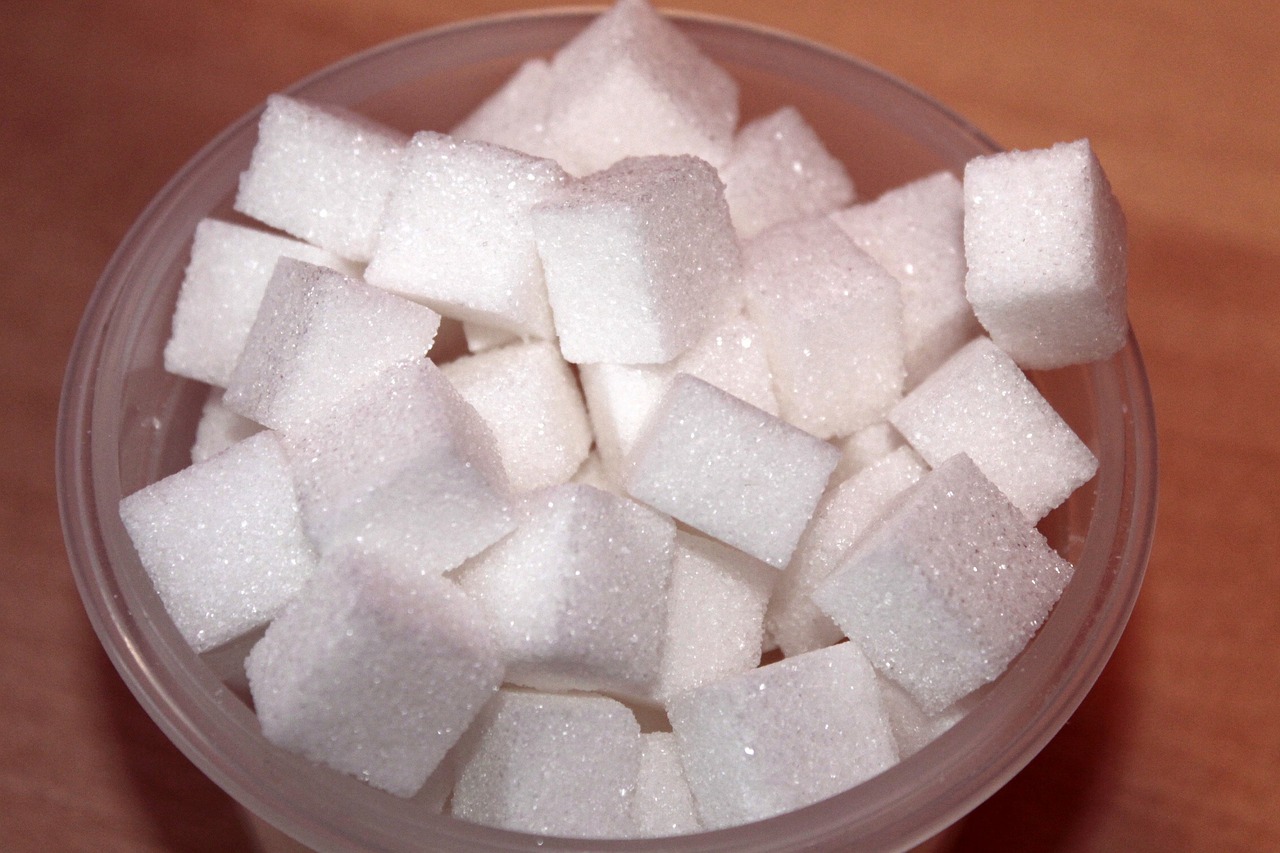
Boooo ... sugar.

Boooo … sugar.

I know many people who have tried a sugar-free diet, both as a constant way of living and as a way to reset their systems. In the latter approach, they spent several days with zero sugar — not even in natural forms, like fruit — and slowly reintroduced it to their diets. Ultimately the intention is to weed out as much added sugar as possible. Natural sugar is not a bad thing, the key word being natural. But added sugar has no nutritional value and no reason for being, other than making foods sweeter and setting us up for a lifetime of cravings.

It’s an understatement to say that there’s a boatload of research on how bad added sugar is for us. There’s a new study that not only links it to heart disease but to a higher risk for death. Another study found that fructose (a form of added sugar) can create a domino effect that causes our “I’m full” sensor to essentially malfunction. Yet another looked at the link between sugar consumption and decreased brainpower. And that’s just scratching the surface.

Research also shows that sugar consumption creates a vicious cycle. You consume it, you crave it, you consume more, you crave more… you get the idea.

So: How much sugar is OK? What kind of sugar is OK? The American Heart Association recommends that women consume no more than 100 calories a day, or about 6 teaspoons’ worth, from added sugars. (For men, it’s 150 calories and 9 teaspoons.)

OK ... in moderation.

Way more than a daily allotment!

For mathematical purposes when you’re reading nutrition labels, 4 g of sugar = 1 teaspoon. So if you’re eating one granola bar that contains chocolate chips that has 12 g of sugar (as I saw on a label of one today), there’s 3 teaspoons, or half your allotment for the day. From one 4-inch granola bar!

It can be hard to determine what portion of the sugars listed on a label are natural and what portion is not. The AHA offers great information about this and much more, here.

Aside from information sharing, my purpose in posting this topic is to share my experience in going sugar-free. For the past 6 days, I’ve been participating in a sugar-free diet test panel. I spent the first 4 days with zero sugar, natural or otherwise. Yesterday, I was able to add fruit back in, along with one serving of refined whole grain.

I had previously scoffed quite seriously at friends who tried this diet. I believe in all things in moderation, I said. Cutting something out just sets you up to really crave the taboo item, I asserted.

So what changed? I read more of the research. I took into consideration my friends’ raves about how great they felt. I realized that I needed a reset of my own — a final piece of the puzzle, if you will, in trying to live as healthfully as possible and eat cleanly.

Yum ... natural sweetness! / Photo by Chris M. Junior

Yum … natural sweetness! / Photo credit: Chris M. Junior

Do I miss ice cream? Yes. Surprisingly, I’m really craving some pizza. (Tomato sauce is generally loaded with sugar, and the white dough ain’t so great, either.) But I’m finding that I can survive without my daily Diet Coke, and that I can pass up the doughnuts and M&M’s in the office. I still love fresh fruit and consider it a yummy treat. And the more days that go by on my “eating clean” calendar, the better and more revved-up I feel. (The weight loss is a welcome side effect too!)

I still believe in “all things in moderation” — but I don’t think I was eating sugars in moderation. I’ll revisit the topic at the end of the test panel time period and let you know how I’m feeling then. In the meantime, I welcome feedback and/or comments if you’ve tried this way of eating yourself.

What about hand weights?

After reading my last entry, Should you wear ankle weights?, several people asked me, “What about wrist or hand weights?”

Limit weights to non-walking workouts. Photo credit: Tiverylucky/FreeDigitalPhotos.net

Limit weights to non-walking workouts. Photo credit: Tiverylucky/FreeDigitalPhotos.net

I’m happy to address that topic.

Generally, my answer is the same: I would not recommend it. And generally, the reasons are the same.

First, I think it’s best to focus on walking while one is walking — and with the proper form and intensity, walking can be a terrific workout all on its own. (Want to learn how? Contact me.)

Also, carrying equipment while walking can increase the chances for injury. It can put unnecessary stress on the joints and muscles of the arms.

Plus, you don’t get much bang for the buck when carrying weights. Doing so increases your heart rate and calorie burn by only a small amount. You can get a good boost instead by employing techniques that can increase the intensity of your workout, such as doing intervals or increasing your overall speed.

In other words, the possible small benefit is countered by the larger risk for injury.

Should you wear ankle weights?

Several people have asked me whether they should wear ankle weights when walking, in part to gain some extra calorie burn and/or to boost the workout aspect.

The short answer is no — you should not wear ankle weights while walking.

be

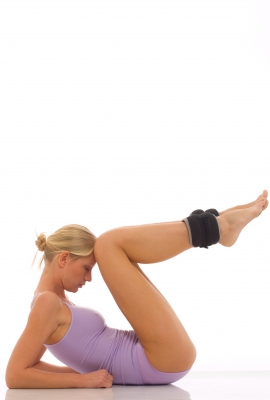
Want to use ankle weights  while working out? Limit it      to something like this: while doing stationary strength training. Photo credit: Ambro/FreeDigitalPhotos.net

Here is the long answer:

  • Strapping weights around your ankles tightly enough so they don’t jostle while you move causes compression, which could compromise blood flow to your feet — not advisable.
  • Ankle weights are an unnatural distribution of extra weight. To concentrate added weight in one spot, particularly around a joint, can cause undue exertion and injury.
  • Wearing ankle weights can throw off your gait. That can tax your joints — not only your ankles but also your knees and your hips, causing strain and injury.
  • Having something strapped around your ankles may pose a tripping hazard. As you walk, you might get tangled up in the extra bulk. Or you might subconsciously widen your legs to keep the weights from bumping or rubbing together, which brings us back to the previous bullet point.
  • Concentrating weight at your ankles — even if only a few pounds — creates a muscle imbalance. Your quadriceps (or the muscles on the front of your thighs) suddenly have more work to do, because that is the muscle that lifts your leg to bend your knee. But your hamstrings (the muscles on the back of your thighs) don’t have an equal extra job.

If you want to boost the effects of your walk by wearing ankle weights, I’d suggest you reconsider. Keep weight training to just that — a weight training session. And keep your cardio efforts to an aerobic exercise session. You’ll get better results in both situations. (However, something like a circuit class, in which you alternate cardio bouts with strength training moves, is designed to be safely effective.)

All that said, if you are looking to turn your walk into a more serious, results-bearing workout, let’s talk. I can help you do so, without extra equipment and with lower chances of injury.